
The unattended retail sector is undergoing a quiet revolution. Once synonymous with canned drinks and bagged snacks, the modern vending machine has evolved into a fully integrated food-service appliance capable of storing, preserving, heating, and dispensing complete frozen meals — all without a single human operator on site. At the centre of this shift is the frozen food vending machine: a networked, refrigerated, microwave-equipped kiosk that brings restaurant-grade convenience to offices, hospitals, transit hubs, and campuses worldwide.
This article provides a technical deep dive into how these machines work, what differentiates leading-edge designs from commodity hardware, and why manufacturers such as Zhejiang Jiafeng Electrical & Mechanical Co., Ltd. are setting new benchmarks for the category.
A frozen food vending machine combines three subsystems that traditionally existed in separate appliances: a commercial refrigeration unit, a microwave heating chamber, and an automated dispensing mechanism. The integration of these three elements into one compact cabinet is what makes the technology commercially viable at scale.
Unlike a standard snack or beverage vending machine — which only needs to maintain ambient or lightly chilled conditions — a frozen food unit must hold products at or below 0 °C continuously, then heat selected items to safe serving temperatures (typically above 74 °C core temperature) within a matter of minutes, and finally deliver the hot product through a retrieval door without contaminating the remaining frozen stock. Managing these competing thermal demands inside a single enclosure is the core engineering challenge.
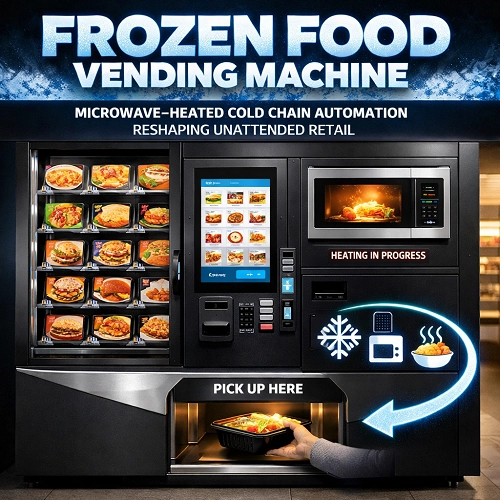
Reliable refrigeration is the foundation of every frozen food vending machine. The Jiafeng model FMM uses a Gaisbery ZM143ZA compressor, a unit recognised in the cold-chain industry for its low-vibration operation, high coefficient of performance (COP), and resilience in environments where ambient temperatures fluctuate. The compressor works in tandem with a purpose-built evaporator coil and a defrost cycle controller to maintain consistent cabinet temperatures across all 105 product slots.
Heating is delivered by a Toshiba 2M248 magnetron — a well-proven industrial-grade component widely used in commercial catering equipment. The magnetron generates microwave energy at 2.45 GHz, which excites water molecules within the food product, producing rapid, even heating. A dedicated heating chamber isolates the process from the refrigerated storage area, preventing thermal cross-contamination. The system is calibrated so that heating cycles are matched to product type, ensuring safe internal temperatures are reached without overcooking.
The brains of the operation is the MI3265 main control board, which coordinates the refrigeration controller, heating module, dispensing actuators, payment terminal, and 4G communication modem. Supporting both Windows and Linux operating systems, the board offers operators flexibility: Linux deployments benefit from lower overhead and greater long-term stability, while Windows environments simplify integration with legacy enterprise retail management software. Firmware updates can be pushed remotely over the 4G link, eliminating the need for on-site engineering visits for software-level maintenance.
The single retrieval door accepts items up to 194 × 135 × 75 mm — a footprint sized to accommodate standard single-serving meal trays and most frozen snack packaging formats. The dispensing mechanism uses a combination of motorised shelving and a gravity-assisted delivery channel to transfer the selected product from its storage slot to the retrieval zone. Crucially, if a heating cycle is selected, the product is routed through the microwave chamber before arriving at the retrieval door, keeping the process fully automated and hygienic.
Consumer payment expectations have expanded dramatically, and the Jiafeng FMM addresses this with support for mobile payment (WeChat Pay, Alipay, QR-code platforms), cash, and credit/debit card. Behind the scenes, a 4G IPC (Industrial PC) module maintains a live data link to the operator's back-end platform, enabling real-time inventory tracking, sales reporting, remote diagnostics, and alert notifications when stock falls below threshold or a hardware fault is detected.
| Parameter | Specification | Notes |
|---|---|---|
| Model | FMM | Microwave Heated Frozen Food Vending Machine |
| Dimensions (H × W × D) | 1990 × 1290 × 835 mm | Fits standard doorway clearance |
| Machine Weight | 480 kg | Requires pallet jack or forklift for installation |
| Number of Containers | 105 | Configurable product mix per slot |
| Max Item Size (retrieval) | 194 × 135 × 75 mm | Standard single-serve meal tray compatible |
| Input Voltage | AC 220 V / 50 Hz | Standard single-phase supply |
| Maximum Current | 20 A | Dedicated circuit recommended |
| Standby Power Consumption | 400 W | Refrigeration-only mode |
| Microwave Component | Toshiba 2M248 Magnetron | 2.45 GHz industrial-grade |
| Refrigeration Compressor | Gaisbery ZM143ZA | Low-vibration, high-COP design |
| Main Control Board | MI3265 | Supports Windows & Linux |
| Data Communication | 4G IPC | Real-time remote management |
| Payment Methods | Mobile / Cash / Credit Card | Multi-modal payment terminal |
| Retrieval Doors | 1 | Heated and non-heated delivery |
| Operating System | Windows / Linux | Remote firmware update supported |
Table 1. Full specification of the Jiafeng FMM Frozen Food Vending Machine. Source: jiafeng-expert.com
The versatility of the frozen food vending machine format means it can generate revenue across a wide range of sectors. The table below maps each deployment environment to its primary demand driver and typical product mix.
| Deployment Sector | Primary Demand Driver | Typical Product Mix |
|---|---|---|
| Corporate Offices | Employee convenience; canteen supplement | Frozen meals, sandwiches, snack packs |
| Education Campuses | 24/7 access outside cafeteria hours | Budget meals, burritos, frozen desserts |
| Hospitals & Clinics | Shift workers; reduced staffed catering hours | Nutritionally balanced frozen meals |
| Transport Hubs | Traveller demand for fast, hot food | Ready meals, hot snacks, beverages |
| Retail & Shopping Centres | Impulse purchase; on-the-go eating | Frozen desserts, pizza slices, snack items |
| Industrial & Logistics Sites | Remote location; no nearby food outlet | High-calorie frozen meals, hot beverages |
Table 2. Deployment environments and product mix recommendations for frozen food vending machines.
Operators evaluating frozen food vending machines must account for running costs that extend beyond the purchase price. With a standby power draw of 400 W, the Jiafeng FMM consumes approximately 9.6 kWh per day in refrigeration-only mode — a figure that compares favourably with stand-alone commercial chest freezers of similar volume. The microwave heating cycle adds a short burst of higher draw (typically 1–2 kW for 2–4 minutes per transaction), but because heating events are intermittent, overall daily energy consumption remains manageable for most commercial tariff structures.
Remote management via the 4G IPC link also reduces operational overhead: operators can identify low-stock slots, malfunctioning actuators, or temperature anomalies from a central dashboard rather than dispatching technicians for routine checks. This has a measurable impact on the total cost of ownership, particularly for operators managing large machine fleets across geographically dispersed locations.
The Jiafeng vending machine product range illustrates how diverse the automated food-service category has become. The table below positions the frozen food vending machine relative to closely related formats:
| Machine Type | Storage Temperature | On-Board Heating | Best Use Case | Jiafeng Product |
|---|---|---|---|---|
| Frozen Food Vending Machine | ≤ 0 °C (frozen) | Yes – microwave | Complete frozen meals & snacks | FMM Model |
| Cold Chain Meal Vending Machine | 2 °C – 8 °C (chilled) | Optional | Chilled ready meals, fresh food | Cold Chain Model |
| Microwave Cold Chain Meal Vending | 2 °C – 8 °C (chilled) | Yes – microwave | Heated chilled meals on demand | Microwave Cold Chain |
| Ice Cream Machine | ≤ −18 °C (deep freeze) | No | Frozen desserts, ice cream bars | Ice Cream Model |
| Noodle Cooking Machine | Ambient / chilled | Yes – boiling water | Fresh noodle dishes | Noodle Cooker |
| Capsule Coffee Machine | Ambient | Yes – hot water | Hot beverages | Coffee Model |
Table 3. Comparison of vending machine types available from Jiafeng. Sources: jiafeng-expert.com/vending-machine
Zhejiang Jiafeng Electrical & Mechanical Co., Ltd. is headquartered at No. 128, Jinxiu Road, Luoxing Street, Jiashan County, Jiaxing, Zhejiang, China — a region long established as a centre of precision manufacturing and electromechanical engineering. The company operates across three core competency areas:
The company also provides comprehensive OEM/ODM services and maintains a dedicated R&D centre staffed with engineers focused on next-generation automated retail solutions. A proprietary Smart Retail Management Platform underpins the remote monitoring and fleet management capabilities offered with each machine. The company has earned multiple industry certifications and counts a broad roster of global partners among its cooperation network.
Contact: +86 133-3583-7295 | +86 135-7533-6233
Email: Jason_he@hontechgroup.com | allen_hsu@hontechgroup.com
For procurement managers and operators considering a frozen food vending machine, the following checklist summarises the most critical evaluation criteria:
The frozen food vending machine represents one of the most technically sophisticated segments within unattended retail. By merging commercial refrigeration, microwave heating, intelligent dispensing, multi-modal payments, and cloud-connected management into a single cabinet, modern units such as the Jiafeng FMM are genuinely capable of replacing, or at least substantially augmenting, staffed food-service operations in a growing range of environments.
As consumer demand for convenient, high-quality food-away-from-home continues to grow — and as cold-chain logistics infrastructure matures in emerging markets — the addressable opportunity for well-engineered frozen food vending machines is expanding rapidly. Manufacturers with end-to-end in-house capabilities, from sheet metal fabrication through to electromechanical integration and proprietary control software, are best placed to meet that demand with reliable, differentiated products.
Explore the full Jiafeng vending machine range:
Frozen Food Vending Machine (FMM) | Cold Chain Meal Vending Machine | Ice Cream Machine | Noodle Cooking Machine | Orange Juice Machine | Capsule Coffee Machine



