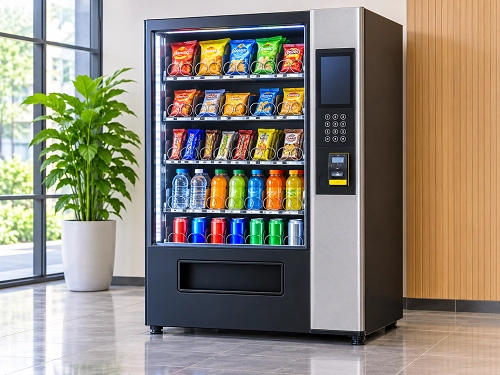
Food vending machines have evolved far beyond traditional snack and beverage dispensers. Today, they can serve fresh meals, sandwiches, salads, frozen foods, hot meals, and even made-to-order products. With improvements in refrigeration, intelligent inventory management, cashless payments, and automated dispensing, food vending machines are becoming a practical solution for businesses looking to provide convenient food access without operating a traditional restaurant.
However, choosing a food vending machine involves more than comparing machine sizes or product capacities. Food type, temperature control, dispensing methods, replenishment frequency, and location all influence whether a machine can operate reliably and deliver a satisfactory customer experience.
For businesses considering food vending equipment, understanding these factors is essential to selecting a machine that meets both operational requirements and customer expectations.
A food vending machine is an automated retail system designed to store, display, and dispense food products without requiring continuous on-site staff assistance.
Unlike conventional snack vending machines, food vending equipment can incorporate specialized storage and dispensing technologies to accommodate different food characteristics.
Depending on the application, a machine may include:
Refrigerated compartments for sandwiches, salads, dairy products, and prepared meals.
Frozen storage systems for ice cream, frozen meals, and other temperature-sensitive products.
Heating modules for hot meals and ready-to-eat food.
Automated elevators or robotic dispensing mechanisms to prevent food from falling or becoming damaged.
Digital payment terminals supporting credit cards, mobile payments, and contactless transactions.
Remote monitoring systems for tracking inventory, sales, and equipment status.
The most important distinction is that food vending machines must accommodate the physical and storage requirements of the products they dispense. A machine designed for packaged snacks, for example, may not be suitable for delicate fresh meals or temperature-sensitive products.
Selecting the right machine starts with understanding what type of food it needs to dispense. Different products require different storage environments, dispensing mechanisms, and operational configurations.
Fresh food vending machines are designed for products with limited shelf lives, including sandwiches, salads, wraps, fruit cups, and prepared meals.
These machines typically use refrigeration systems to maintain suitable storage temperatures. Adjustable shelves and product compartments help operators accommodate different packaging dimensions.
Key considerations:
Consistent temperature control throughout the storage area.
Suitable packaging dimensions and shelf arrangements.
Easy-to-clean interior surfaces.
Inventory rotation and expiration date management.
Temperature monitoring and alarm functions.
For operators selling fresh food, refrigeration performance is particularly important. A machine should maintain stable temperatures even when its door is frequently opened during restocking or when ambient temperatures fluctuate.
Hot food vending machines provide customers with heated meals through automated dispensing or integrated heating systems.
Common products include pizza, burgers, noodles, rice meals, and other ready-to-eat foods.
Depending on the design, machines may use microwave heating, convection heating, or other controlled heating technologies.
The key technical challenge is ensuring that food reaches an appropriate serving temperature while maintaining consistent quality.
Operators should evaluate:
Heating time and temperature consistency.
Compatibility with different food containers.
Ventilation and heat management.
Cleaning requirements.
Food handling and cross-contamination controls.
It is also important to distinguish between machines that simply heat pre-prepared meals and those that perform multiple preparation steps. Their mechanical complexity, maintenance requirements, and operating costs can differ considerably.
Frozen food vending machines are designed to store products at controlled sub-zero temperatures.
Typical applications include frozen meals, ice cream, frozen desserts, and packaged frozen ingredients.
Compared with refrigerated machines, frozen vending equipment requires more demanding insulation and cooling performance.
Important features include:
Reliable freezer compressors.
Effective thermal insulation.
Automatic defrost management where applicable.
Temperature alarms.
Door sealing and condensation control.
A suitable frozen vending machine should also recover its target temperature efficiently after restocking and during periods of frequent customer use.
Some specialized food vending machines combine storage, heating, and automated preparation processes.
Pizza vending machines are one example. Depending on the system, they may store prepared pizzas, heat them automatically, and dispense finished products within a designated time.
These machines require more sophisticated control systems than standard vending equipment.
Their performance depends on coordination between product storage, mechanical movement, heating elements, sensors, and dispensing mechanisms.
For operators, the main consideration is whether the machine can consistently deliver the expected product quality without excessive maintenance or complicated daily operations.
A food vending machine is an integrated system involving refrigeration, mechanical components, electrical controls, software, and payment technology.
Understanding these systems helps buyers evaluate equipment beyond its external appearance.
Temperature management is one of the most important technical considerations for refrigerated and frozen food vending machines.
A reliable refrigeration system should provide:
Stable temperature regulation.
Appropriate cooling capacity for the machine's internal volume.
Temperature sensors positioned to provide meaningful monitoring.
Automatic alerts when temperatures exceed configured limits.
Effective insulation to reduce heat transfer.
Buyers should ask manufacturers about the cooling system's operating temperature range, temperature recovery performance, refrigerant specifications, and energy consumption.
One important point is that the temperature displayed by a controller does not necessarily represent the temperature of every product inside the machine. Air circulation, shelf positioning, packaging density, and door-opening frequency can create temperature variations.
For this reason, operators should verify actual product storage conditions during commissioning and routine operation.
The dispensing mechanism directly affects product protection and customer satisfaction.
Traditional spiral mechanisms work well for many packaged snacks, but they may not be appropriate for delicate food containers or products that can easily become damaged.
Alternative dispensing technologies include:
|
Dispensing system |
Suitable applications |
Main consideration |
|---|---|---|
|
Spiral conveyor |
Packaged snacks and selected food containers |
Product dimensions and stability |
|
Conveyor belt |
Boxed meals and packaged products |
Accurate positioning |
|
Elevator delivery |
Fragile meals and bottled products |
Mechanical reliability |
|
Robotic retrieval |
Flexible product arrangements |
Higher system complexity |
|
Locker-style compartments |
Prepared meals and larger packages |
Individual compartment management |
For fragile food products, an elevator or controlled delivery mechanism can reduce the risk of products dropping from considerable heights.
The ideal solution depends on product weight, packaging shape, dimensions, and the expected dispensing frequency.
Modern food vending machines increasingly rely on integrated digital control systems.
Common payment options include:
Credit and debit cards.
NFC contactless payments.
Mobile payment applications.
QR-code payments.
Cash and coin systems, where required.
The machine's control system should coordinate payment confirmation, product selection, dispensing, and transaction records.
A particularly important function is transaction recovery. If a payment is successful but the product cannot be dispensed, the system should provide a clear error response and support refunds or operator intervention.
For businesses operating multiple machines, cloud-based management systems can provide centralized access to sales records, inventory information, and equipment alerts.
Remote monitoring can significantly reduce the workload associated with operating vending machines across multiple locations.
Depending on the software platform, operators may be able to monitor:
Remaining product quantities.
Daily and monthly sales.
Refrigeration or freezer temperatures.
Machine operating status.
Payment errors.
Equipment faults.
Restocking requirements.
However, remote monitoring is only valuable when the collected information is accurate and actionable.
For example, inventory tracking based solely on successful sales may become inaccurate if a product is manually removed, damaged, or incorrectly loaded.
A practical system should allow operators to reconcile inventory during restocking and identify discrepancies between recorded stock and actual quantities.
Food safety is not simply a feature of the vending machine. It depends on the entire operating process, including food preparation, transportation, loading, storage, dispensing, and cleaning.
This is particularly important for machines selling fresh meals and other perishable products.
Operators should establish appropriate temperature limits based on the food category and applicable local food safety regulations.
In the United States, the FDA Food Code provides a regulatory model for retail food safety. The applicable requirements may vary depending on state and local adoption.
For example, time and temperature control for safety foods generally require appropriate cold or hot holding controls.
A responsible operator should:
Verify storage temperatures before loading food.
Check that the refrigeration system is functioning correctly.
Maintain temperature records.
Establish procedures for temperature deviations.
Remove products that cannot be confirmed safe for sale.
A machine's temperature alarm should not replace an established food safety management procedure.
Fresh food vending machines require particularly careful inventory management.
The first-in, first-out (FIFO) approach helps ensure that older products are sold before newer stock.
For products with strict use-by dates, operators should also maintain clear expiration records and remove products before they become unsuitable for sale.
A more advanced inventory system may support barcode scanning, batch identification, and automated expiration alerts.
Food residue, spills, condensation, and frequent customer contact can create hygiene challenges.
Operators should establish cleaning schedules covering:
Product storage compartments.
Shelves and dispensing areas.
Touchscreens and payment terminals.
Door handles and frequently touched surfaces.
Drainage areas and condensation collection points.
Heating components, where applicable.
Materials used inside the food storage area should be suitable for the intended food environment and compatible with the cleaning chemicals specified by the manufacturer.
There is no single food vending machine that works equally well for every business.
A suitable purchasing decision should begin with the products, operating environment, and expected customer demand.
Start by defining exactly what you intend to sell.
For example:
|
Food category |
Recommended machine configuration |
|---|---|
|
Sandwiches and salads |
Refrigerated storage |
|
Packaged fresh meals |
Refrigerated shelves or compartments |
|
Ice cream |
Frozen storage |
|
Hot prepared meals |
Integrated heating system |
|
Pizza |
Specialized pizza vending system |
|
Packaged snacks |
Spiral or conveyor dispensing |
Do not select a machine based only on its advertised product capacity. Packaging dimensions and storage requirements can be more important than the total number of products it holds.
The installation location influences machine performance and customer demand.
Potential locations include:
Office buildings.
Hospitals and healthcare facilities.
Universities and schools.
Factories and industrial parks.
Transportation hubs.
Hotels and residential communities.
Shopping centers.
Each location has different operating characteristics.
An office building may experience concentrated demand during lunch breaks, while a hospital may require longer operating hours and a broader range of food options.
Operators should also evaluate available electrical capacity, ventilation, network connectivity, installation space, and accessibility for restocking and maintenance.
The purchase price is only one part of the investment.
A realistic cost evaluation should include:
Equipment purchase price.
Transportation and installation.
Electricity consumption.
Payment processing fees.
Software or connectivity charges.
Food inventory.
Restocking labor.
Cleaning and sanitation.
Spare parts and maintenance.
Product spoilage and waste.
For refrigerated and frozen machines, energy consumption deserves particular attention because cooling systems may operate continuously.
Buyers should request actual energy consumption data under defined operating conditions rather than relying exclusively on estimated marketing figures.
Food vending machines can reduce certain labor and storefront costs, but profitability depends on location quality, product selection, sales volume, and operating efficiency.
A useful way to evaluate a potential installation is to calculate its contribution margin.
Example:
Assume a machine sells 40 meals per day at an average selling price of $8.
|
Item |
Monthly amount |
|---|---|
|
Daily sales |
40 units |
|
Average selling price |
$8 |
|
Monthly revenue (30 days) |
$9,600 |
|
Food cost per unit |
$3.20 |
|
Monthly food cost |
$3,840 |
|
Gross profit before other operating expenses |
$5,760 |
This is not net profit. Additional costs such as electricity, rent or location commissions, payment processing, labor, maintenance, and food waste must still be deducted.
For example, a high-selling meal may generate less profit than a lower-selling product with a better margin. Understanding both sales volume and contribution margin helps businesses optimize their product mix.
Regular maintenance helps prevent equipment failures, product losses, and unnecessary downtime.
Unlike conventional vending machines, food vending equipment may contain refrigeration units, heating components, food-contact surfaces, and more complex dispensing mechanisms.
A practical maintenance schedule should include the following:
|
Frequency |
Maintenance tasks |
|---|---|
|
Daily |
Check temperature readings, product dates, cleanliness, and machine status |
|
Weekly |
Inspect dispensing mechanisms, door seals, drainage, and product shelves |
|
Monthly |
Check cooling performance, electrical connections, ventilation, and software alerts |
|
Periodically |
Arrange professional inspection of refrigeration and heating systems |
Operators should also maintain a record of recurring faults.
For example, repeated temperature fluctuations may indicate poor ventilation, damaged door seals, excessive restocking activity, or a refrigeration problem.
Identifying the underlying cause is more effective than repeatedly resetting the machine.
Choosing the manufacturer is just as important as selecting the equipment itself.
A machine may look attractive in a product catalog, but its actual performance depends on engineering quality, component selection, software integration, and after-sales support.
Before placing an order, buyers should evaluate the following areas.
Different businesses have different requirements.
A manufacturer should be able to explain available customization options, including:
Machine dimensions and appearance.
Storage temperature configurations.
Shelf layouts and product capacities.
Dispensing mechanisms.
Payment terminal compatibility.
Branding and exterior design.
Remote management functions.
Customization should be evaluated against the actual operating requirements rather than treated as an aesthetic upgrade.
Ask about the major components used in the machine.
Important areas include refrigeration compressors, temperature sensors, motors, control boards, touchscreens, payment modules, and dispensing assemblies.
Buyers should request component specifications and information about replacement part availability.
A reliable manufacturer should have a defined testing process before shipment.
Relevant testing may include:
Refrigeration performance testing.
Temperature stability testing.
Repeated dispensing cycle testing.
Payment system testing.
Electrical safety testing.
Door and sealing inspections.
Software and communication testing.
For customized equipment, buyers should also confirm that the final machine has been tested with the intended product packaging.
A machine that cannot be repaired quickly may generate substantial losses, especially when it stores perishable food.
Before purchasing, clarify:
Warranty coverage.
Technical support availability.
Spare parts supply.
Troubleshooting documentation.
Remote diagnostic capabilities.
Maintenance training.
Software updates.
For overseas buyers, it is particularly important to understand international shipping arrangements, local service options, and the availability of replacement components.
The food vending industry is moving toward more connected, flexible, and data-driven equipment.
Several developments are likely to influence future machine designs.
AI-assisted inventory management: Sales history and demand patterns can help operators forecast replenishment requirements and reduce food waste. These systems are most useful when they are supported by accurate inventory data.
Smart temperature monitoring: Connected sensors can provide continuous temperature records and notify operators when refrigeration performance deviates from configured limits.
Flexible dispensing systems: More adaptable dispensing mechanisms can support different food packaging formats, making it easier for operators to expand their product selection.
Cashless and contactless payments: Integrated digital payment systems can simplify transactions and improve convenience for customers.
Energy-efficient refrigeration: Improved insulation, refrigeration components, and control strategies can help reduce electricity consumption without compromising required storage conditions.
These developments do not eliminate the need for proper maintenance or food safety procedures. Their value lies in making everyday operations more manageable and measurable.
Depending on the machine configuration, food vending machines can sell sandwiches, salads, packaged meals, snacks, frozen foods, ice cream, pizza, and hot meals. Product selection should match the machine's storage temperature, packaging dimensions, and dispensing capabilities.
Not all food vending machines require refrigeration. Machines selling fresh or temperature-sensitive food generally need appropriate refrigeration or freezing systems. Machines dispensing shelf-stable packaged snacks may operate without active cooling.
Food vending machines support food safety through temperature control, monitoring sensors, suitable storage compartments, and automated alerts. However, operators must also implement proper food handling, expiration date management, cleaning, and temperature verification procedures.
Restocking frequency depends on daily sales, product shelf life, storage capacity, and delivery arrangements. Machines selling fresh meals may require daily replenishment, while machines selling shelf-stable packaged foods may need less frequent visits.
Yes. Many modern machines support contactless bank cards, NFC payments, QR codes, and mobile payment systems. Buyers should confirm that the payment hardware and software are compatible with the payment providers in their target market.
Yes, provided the equipment is designed for continuous operation and the installation environment meets its electrical, ventilation, and temperature requirements. Operators must also arrange appropriate restocking, cleaning, monitoring, and maintenance schedules.
A standard vending machine generally focuses on packaged snacks and beverages with relatively simple storage requirements. A fresh food vending machine requires more sophisticated temperature management, food inventory controls, and cleaning procedures to accommodate perishable products.