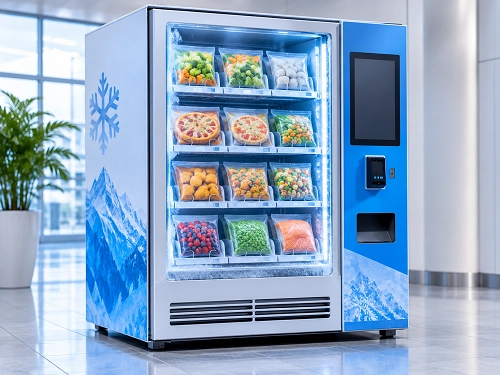
Selling a frozen meal from an unattended machine looks simple. The machine has to hold product at freezer temperature, deliver it intact, heat it evenly without anyone stirring it, and report faults before food is lost. Each step depends on engineering choices that rarely show up in a brochure. This article explains how these machines work, where the technical risks are, and what to ask a supplier before you buy.
Key takeaways
- Frozen, chilled and ice-cream vending are three different thermal problems. Do not treat them as one category.
- Food held constantly at 0 °F (−18 °C) or below stays safe, and storage-time limits are about quality, not safety.
- Microwaves heat unevenly and can leave cold spots where bacteria survive.
- Before you commit to a site, work out the electrical load, floor load, ventilation and mobile signal.
- Ask for the numbers a product page may omit, such as the freezer setpoint and the heating time per meal. A checklist appears below.
1. Frozen, chilled and ice cream: three different machines
Jiafeng's published range shows why the distinction matters. Its microwave-heated cold chain meal machine stores food at about 5 °C. That suits chilled meals, and it adds UV disinfection and ozone sterilization. The FC03 ice cream machine publishes an adjustable range of −23 to 0 °C and uses a mechanical arm to pick products. The FMM is built for frozen meals, snacks and desserts, with a compressor refrigeration system and an integrated microwave.
Note that the FC03's range includes settings warmer than −18 °C, and the FMM page does not publish a numeric setpoint. For frozen meals, confirm the actual operating setpoint in writing. It should be at or below −18 °C.
Table 1. Three Jiafeng machines compared (published specifications)
| Parameter | FMM frozen food, microwave | VMC08855W0 chilled meals, microwave | FC03 ice cream |
|---|---|---|---|
| Best for | Frozen meals, snacks, desserts | Chilled ready meals | Ice cream, frozen desserts |
| Storage temperature | Frozen (setpoint not published) | About 5 °C | −23 to 0 °C |
| Heating | Toshiba 2M248 magnetron | 2.6 kW microwave system | None |
| Capacity | 105 containers | 88 aisles | Up to 28 aisles |
| Size H × W × D (mm) | 1990 × 1290 × 835 | 1915 × 1382 × 976 | 1860 × 1025 × 916 |
| Weight | 480 kg | 480 kg | 247 kg |
| Electrical | AC220V/50Hz, 20 A max, 400 W standby | 220V/50Hz, 16 A max, 3.5 kW max | 220V/50Hz, 5 A max, 1.1 kW max |
| Control and OS | MI3265 board, Windows/Linux | Industrial PC, 55" touch screen, Windows/Android | Industrial PC, 10.1" touch screen, Windows/Android |
| Connectivity | 4G IPC | 4G / Wi-Fi / LAN | 4G / Wi-Fi / LAN |
| Payment | Mobile, cash, credit card | Mobile, cash, credit card | Mobile, cash, credit card |
Source: Jiafeng product pages for the FMM, the VMC08855W0 and the FC03. Values are as published on November 25, 2026.
For a broader overview of the category, see Jiafeng's earlier article on frozen food vending machines.
2. How a frozen-meal vending cycle works
The FMM page describes this sequence: the customer selects a product on the touchscreen and pays, the machine retrieves the item from one of its 105 containers, heats it if it is a hot meal, and delivers it through a single retrieval door. The figure below is a simplified process flow, not a physical layout.
Figure 1. Simplified process flow of a frozen vending cycle.
The published component list translates into operator-level consequences:
- Compressor refrigeration (ZM143ZA, Gaisbery). This holds the cabinet at freezer temperature. The page lists 400 W standby consumption, which drives your running cost (see section 4).
- Microwave heating (Toshiba 2M248 magnetron). A magnetron generates the microwave energy. Heating time and power profile per product are software settings, so they should be tuned per SKU.
- Main control board (MI3265, Windows/Linux). This runs the interface, payment logic and dispensing sequence.
- 4G IPC connectivity. This supports remote monitoring of inventory and faults. It also means mobile signal at the install location is a real requirement.
If you are comparing how different machine types pick products, our spiral coil mechanism guide explains why coils suit snacks while robotic or arm-based pickers suit fresh and irregular items.
3. The hard part: heating frozen food with nobody there
Frozen food is harder to microwave evenly than chilled food. Ice absorbs microwave energy far less readily than liquid water, so areas that thaw first can absorb more energy and overheat while other areas stay frozen. This is a well-established effect in microwave food engineering. USDA guidance makes the food-safety point directly: microwave ovens can cook unevenly and leave cold spots where harmful bacteria can survive, which is why it advises stirring or rotating food partway through and allowing standing time.> A vending machine cannot stir. The engineering has to move into three places:
- Package geometry. The FMM accepts items up to 194 × 135 × 75 mm, a bounding volume of roughly 1.96 litres. Flat trays of even thickness heat more predictably than tall or irregular shapes. Use microwave-safe trays and vented film.
- Per-product heating profiles. Each SKU needs its own time and power setting, set for the coldest realistic starting temperature, not an average one.
- Documented validation. Probe each product at several points, including the centre and corners, after the standing time, across multiple units and repeated cycles. USDA consumer guidance recommends reheating leftovers and poultry to 165 °F (74 °C) and checking with a food thermometer. Commercial vending is regulated locally, so confirm which target temperature and licensing rules apply in your market.
The same reasoning applies to storage. Freezing at 0 °F (−18 °C) or below stops microorganisms from growing, but it is not a one-way street. USDA advises against refreezing food that has been left out of refrigeration for more than two hours, or one hour above 90 °F (32 °C). For operators, that means a compressor failure or prolonged power cut should trigger a written discard rule, not a judgment call at the machine. Use the 4G alerts to catch these events early.
4. Site planning: power, floor load, ventilation, signal
Electrical. The FMM is specified at AC220V/50Hz with a 20 A maximum current, about 4.4 kVA at peak. Plan a dedicated, properly grounded circuit sized by a licensed electrician. If your market uses a different voltage or frequency, ask about a regional configuration. Jiafeng's vending machine overview lists AC 110–240 V, 50/60 Hz as the standard range for its product line, and custom electrical specs are handled through OEM/ODM.
Running cost. The page quotes 400 W standby. If that load were drawn continuously, it would use 9.6 kWh per day. Real consumption depends on compressor cycling, ambient temperature and door activity, and every heating cycle adds to it. Treat the table below as a planning ceiling for standby alone, not a forecast.
Table 2. Standby energy cost at 400 W continuous (planning ceiling)
| Electricity price (per kWh) | Per month (288 kWh) | Per year (3,504 kWh) |
|---|---|---|
| $0.10 | $28.80 | $350.40 |
| $0.15 | $43.20 | $525.60 |
| $0.25 | $72.00 | $876.00 |
Calculation: 0.4 kW × 24 h = 9.6 kWh per day; 30-day month = 288 kWh; 365 days = 3,504 kWh. Prices are illustrative assumptions, so substitute your local tariff.
Floor load. At 480 kg empty on a footprint of about 1.29 × 0.835 m (roughly 1.08 m²), the average is about 446 kg/m² before any stock is loaded. The weight bears on the feet, so the local load is higher. Check the structure with the building engineer, especially on upper floors.
Space and ventilation. The unit stands 1990 mm tall, so check ceiling, doorway and lift dimensions for delivery. Compressor-cooled cabinets need airflow around them, and Jiafeng's own installation notes for its cooled machines call for adequate ventilation.
Network. The FMM lists 4G IPC only. Test mobile signal where the machine will stand, since basements, plant rooms and hospital corridors are common weak spots. If you need Wi-Fi or LAN, ask about it in the quotation stage.
5. Buyer's checklist: questions to put to any supplier
- What is the operating freezer setpoint, and is there a temperature log or alarm threshold for excursions?
- What are the recommended heating time and power for each of my products, and who validates them?
- How many meals can the machine heat per hour at peak? Is there a queue or wait-time display?
- Which certifications apply to this model and my market? The vending machine overview page lists CE, FCC and RoHS for standard models, so confirm this for the model you are buying.
- What is the voltage and plug configuration for my country, and what circuit does it need?
- Which components are standard, replaceable parts? What are the spare-parts and service arrangements?
- What does the remote platform report, and in which languages? Can alerts be sent to my phone or email?
- What are the lead times for a standard unit and for a customised one? The overview page quotes 7–15 days for standard models and 25–60 days for OEM/ODM builds. Confirm the figure for your configuration.
The FMM page does not publish a numeric freezer setpoint, heating time per meal or throughput, so questions 1 to 3 are worth asking in writing before you order.
6. Customisation and next steps
Frozen products vary widely in pack size, so many operators need changes to container dimensions, interface language or payment integration. Jiafeng's OEM/ODM service covers industrial and structural design, PCB design, MCU programming and software, and a multilingual smart retail management platform. The cabinets are built in-house; the vending machine overview describes the sheet metal, machining and electromechanical capabilities behind them. Company background and certifications are on the About us page.
To discuss a deployment, send your products' pack dimensions, target locations and local voltage through the contact page. For more articles like this one, browse Industry News.
Frequently asked questions
Can a frozen food vending machine heat meals as well as store them?
Yes. The FMM combines frozen storage with an integrated microwave so a selected item can be heated before it is delivered. Heating is optional per product, so the same machine can also dispense items that are eaten frozen, such as desserts.
How cold must the machine keep food?
USDA states that food stored constantly at 0 °F (−18 °C) or below remains safe. Treat that as the minimum design target, and confirm the actual setpoint with your supplier.
What size of product fits?
The FMM retrieval door and containers accept items up to 194 × 135 × 75 mm. Measure your packaged product, including film and any sleeve, before you commit.
Is a frozen machine or a chilled machine better?
It depends on the product and the logistics. A chilled machine such as the microwave-heated cold chain meal machine suits fresh meals with a short shelf life and restocking every day or two. Frozen suits longer shelf life, fewer restocking visits and less spoilage risk between visits.