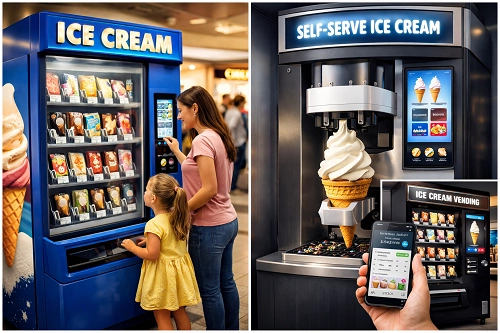
In recent years, the Ice Cream Vending Machine has become an increasingly common sight in shopping malls, airports, schools, office buildings, and entertainment venues. Once considered a novelty, these machines are now a serious business solution for entrepreneurs and an attractive convenience for consumers. But why are ice cream vending machines so popular, and are they truly profitable?
The popularity of the Ice Cream Vending Machine can be attributed to changing consumer behavior and advances in vending technology. Modern consumers value speed, convenience, and accessibility, and vending machines deliver all three.
First, ice cream is an impulse purchase. People often crave it unexpectedly, especially in high-traffic locations. An Ice Cream Vending Machine allows customers to satisfy that craving instantly, without waiting in line or interacting with staff.
Second, technology has greatly improved reliability and quality. Today’s machines maintain precise freezing temperatures, accept cashless payments, and offer attractive digital displays. These features make the Ice Cream Vending Machine both user-friendly and visually appealing.
Finally, the rise of unmanned retail and 24/7 operations has played a major role. Businesses and property owners appreciate that an Ice Cream Vending Machine can operate continuously with minimal supervision, making it ideal for modern, fast-paced environments.
One of the biggest advantages of an Ice Cream Vending Machine is low labor cost. Unlike traditional ice cream shops, vending machines require no full-time staff, significantly reducing operational expenses.
Another key benefit is space efficiency. An Ice Cream Vending Machine occupies far less space than a retail store or kiosk, making it suitable for locations where square footage is limited but foot traffic is high.
Consistency is also a major advantage. Every product is stored at optimal temperatures, ensuring consistent quality and reducing the risk of spoilage when properly maintained.
From a business perspective, ice cream vending machines are highly scalable. Once an operator understands the logistics of stocking, maintenance, and site selection, expanding to multiple machines becomes relatively straightforward.
Despite their benefits, the Ice Cream Vending Machine is not without drawbacks. One of the primary challenges is the initial investment. High-quality machines with advanced refrigeration and payment systems can be expensive.
Maintenance is another concern. Ice cream machines require regular cleaning, temperature monitoring, and occasional repairs. If a machine breaks down, products may spoil quickly, leading to losses.
Limited product variety can also be a disadvantage. While an Ice Cream Vending Machine can offer multiple flavors and brands, it still cannot match the customization or novelty of a full-service ice cream shop.
Lastly, performance is highly dependent on location. Poor placement in low-traffic areas can result in weak sales, regardless of machine quality.
The profitability of an Ice Cream Vending Machine largely depends on location, product pricing, and operational efficiency. In high-traffic areas such as malls, tourist attractions, hospitals, or transportation hubs, ice cream vending machines can be very profitable.
Profit margins on ice cream are generally strong, especially when products are sourced in bulk. With low ongoing labor costs, much of the revenue generated by an Ice Cream Vending Machine can translate into profit once the initial investment is recovered.
However, profitability is not guaranteed. Operators must account for electricity costs, maintenance, restocking logistics, and potential downtime. Successful owners treat the Ice Cream Vending Machine as a business, not a passive income source, and actively monitor performance and inventory.
There are several types of Ice Cream Vending Machine, each designed to serve different business needs and environments.
The most common type is the pre-packaged ice cream vending machine. These dispense branded ice cream bars, cones, and cups and are widely used due to their reliability and simplicity.
Soft-serve ice cream vending machines are more advanced and offer freshly dispensed ice cream. While appealing, they are more expensive and require stricter cleaning and maintenance procedures.
Some machines focus on novelty or premium products, such as gelato or mochi ice cream. These specialized Ice Cream Vending Machine models are often found in upscale locations or niche markets.
Smart vending machines incorporate AI, touchscreens, and remote monitoring. These machines provide real-time sales data and inventory alerts, helping operators optimize performance.
The Ice Cream Vending Machine has evolved from a simple snack dispenser into a sophisticated retail solution. Its popularity stems from convenience, technological innovation, and changing consumer habits. While there are clear advantages such as low labor costs and scalability, potential drawbacks like maintenance and location dependency must be carefully managed.
For entrepreneurs willing to invest time and planning, an Ice Cream Vending Machine can be a profitable and scalable business opportunity. As technology continues to advance and demand for unmanned retail grows, ice cream vending machines are likely to become even more common in the years ahead.