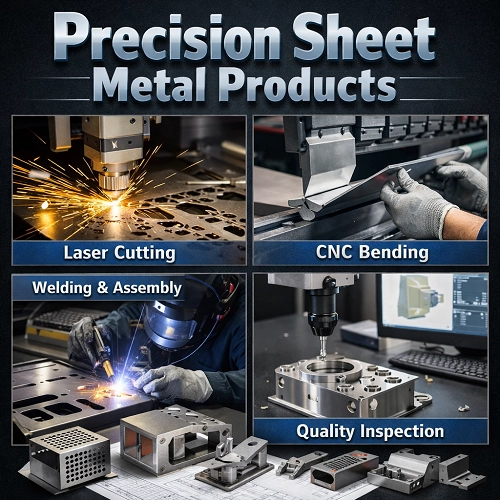
An in-depth exploration of technologies, challenges, and advanced engineering in precision sheet metal manufacturing.
Precision sheet metal products are everywhere—structural frameworks in aerospace assemblies, rugged enclosures for defense electronics, and intricate housings in industrial machinery. At their best, these components meld tight tolerances, engineered strength, and repeatable quality into systems that perform reliably under demanding conditions.
Precision sheet metal products consist of components derived from flat metal sheets that have been cut, formed, joined, and finished to exacting specifications. Unlike general sheet metal work (which might focus on ductwork or basic enclosures), precision parts are engineered for high performance and repeatability, often with tolerances measured in thousandths of an inch and surface finishes optimized for end-use applications across aerospace, defense, medical devices, and industrial systems.
Precision manufacturing begins with accurate material separation:
Press brakes and other forming tools shape the flat sheet into functional three-dimensional parts. Precise control of bend angles, radii, and allowances is critical—errors can lead to misfits that stack up in assemblies. Simulation tools and bend standards help mitigate challenges like springback and tool wear.
Complex assemblies demand expert joining techniques:
High-precision CNC machining supplements metal fabrication, especially for features that require exact surface geometry, bores, or finish requirements. Combining sheet work with machining under one roof streamlines production and offers better geometric control.
After structural fabrication, components may undergo surface treatments like:
These processes enhance corrosion resistance, aesthetics, and performance in severe environments.
Precision fabricators work with a wide range of metals:
Each material brings unique forming characteristics. For example, harder alloys can be more difficult to bend cleanly without cracking, and thickness variations can impact bend allowances.
High precision means very tight tolerances. For some applications, dimensional tolerances are specified in thousandths of an inch. These constraints require rigorous process control, including CNC programming, tool calibration, and careful metrology checks using CMMs and other advanced inspection tools.
Advanced components may feature multiple bends, cutouts, and interfaces. Engineers must reconcile functional design with manufacturability:
Precision fabrication relies heavily on CAD/CAM integration. Accurate modeling, unfolding of sheet metal parts, and generating machine toolpaths directly from the digital model improve efficiency and reduce errors. Inconsistent or ambiguous drawings can propagate costly mistakes downstream.
In industries where failure is not an option, quality systems are foundational:
Inspection technologies like coordinate measuring machines (CMMs), optical comparators, and penetration testing are used to validate that each part meets specification at every stage of production.
Despite advanced technology, sheet metal fabrication faces ongoing challenges:
Emerging trends are pushing precision sheet metal beyond traditional boundaries:
Precision sheet metal products exemplify the intersection of engineering, automation, and craftsmanship. Fabricating components that meet exacting specifications demands advanced technologies, deep material knowledge, rigorous quality systems, and a commitment to solving complex technical challenges. Whether for aerospace flight hardware, defense electronics, or precision industrial equipment, this discipline continues to evolve, driven by innovation and the need for ever higher performance and reliability.